Early Years Foundation Programme
What is EYFP?
VKE’s Early years foundation programme is a holistic educational programme using the concepts inspired by great educationists like Howard Gardner, Loris Malaguzzi, Glenn Doman, Dr.Maria Montessori etc. In Victorious Kidss Educares the child can take admission as soon as he or she is six weeks old. Babies and toddlers are made to feel safe and secure. We believe that children learn best through play – a child’s work. Our emphasis is on how to learn and not what to learn.
Education Starting Before Birth
At Victorious Kidss Educares education starts as soon as the mother conceives. Research has shown that the unborn child is a highly responsive being, who is constantly acquiring new skills. A masterpiece of human excellence in education, starts from the prenatal days. In this case, it is the mother herself who proceeds with this education. This is our own tradition (Abhimanyu Concept), which we have completely forgotten.
At Victorious Kidss Educares, we have a special educational programme for prospective mothers so that the child can come into the world with her/his utmost potentialities. Says Neuro-Surgeon and educationist Glenn Doman, “If you don’t use it, you lose it.” Try this if you wish to begin sharing our awe. If you happen to be pregnant right now look at your watch and count out exactly sixty seconds. During one minute your un-born baby gains approximately a quarter of million new brain cells. This implies, if we do not feed data worth 250,000 units of facts, our babies lose out their brain potential even before it is out in the world.
How does it work?
Play is the work of every child and initiates inquiry and actively engages children which helps them develop their intellectual, emotional, physical, social abilities. Play being the method of teaching in our Early Years Foundation Programme and the learning experiences that babies and toddlers have in class, help build their understanding, creativity, knowledge, skills and make sense of the world.
When babies and toddlers play they
- • Explore the world – natural and social
- • Learn about themselves
- • Experiment with new ideas including symbolic competence required for formal learning
- • Develop and expand their language skills
- • Build their social, communication, thinking and other cognitive skills and abilities
- • Learn life skills like managing time, problem solving, reasoning etc.
- • Gives them a choice to enhance their interest and passion
Play is a great way for children to learn using their senses. We at VKE promote play for babies, toddlers, and all children. Learning is fun as play, and this nurtures our children to become positive, responsible, and lifelong learners.
Our Curriculum
An education of the head, the heart and the hand are “for one’s own liberation and for the good of the world” as Swami Vivekananda put it. This approach is for a child to discover their superpower hidden within. We aim to create happy, positive, healthy and successful children. We need this kind of education by which character is formed, strength of mind increased, the intellect is expanded, and by which one can stand on one’s own feet (Swami Vivekananda, Collected Works, Volume 5, p342)
In VKE we focus on 6 domains which are further bifurcated into developmental milestones as per the different phases. These domains are important because they all contribute to the child's development in one way or another. Children learn through play activities in a loving and inclusive environment that will set them up for a lifetime of success.
SIX Domains are as follows:
EYFP Head: Saakshi Suryavanshi Age: 6 weeks old - 3 year old
EYFP Coordinator: Harshita Masand
What Do Toddlers Learn?
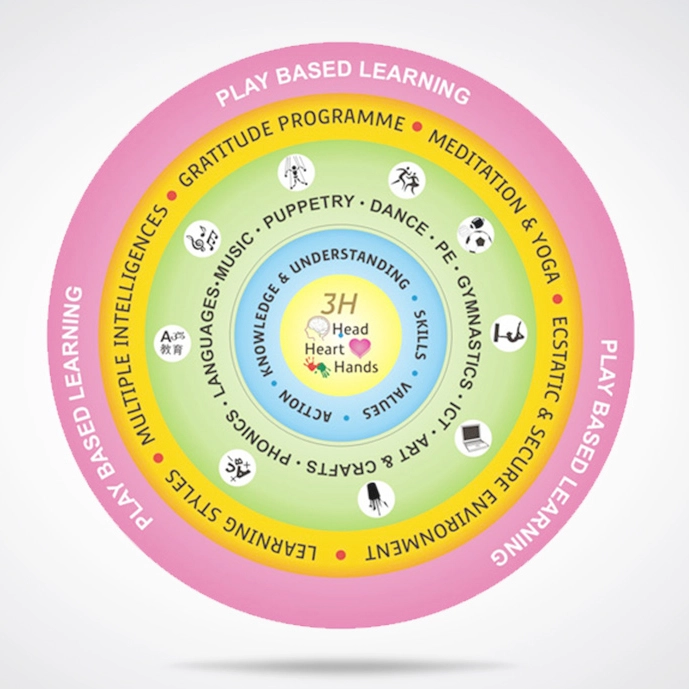
3H: Head, Heart and Hands
The aim of having the ‘Head, Heart and Hands’ in our learning approach was to give a holistic, integrated, experimental and experiential exposure to our learners. Well-rounded learning experiences help a child to develop in all domains of learning. Wonder and Reasoning, Making connections, Milestones, Multisensory & Values.
Babies and toddlers learn a lot more than what is taught in lessons at our Early Years Foundation Programme. Learning is an ongoing process and every child learns at his or her own pace.
Babies and toddlers are filled with wonderings, born curious, and we want this curiosity to become a way to inquire into the world around them. Milestones are the checkpoints in a child’s developmental growth. Understanding of the developmental milestones help us to support the learning of babies and toddlers and have intentional planning and teaching.
Multisensory learning means using your senses to learn. Multisensory teaching techniques stimulate the brain so that each sensory system becomes more developed and effective on which all future learning will be based.
Values are the guiding principles that help our babies and toddlers to make the correct decisions, right choices and have a purpose as they grow and bring balance in life.